Stop counting every line and space. Use middle C, A-C-E landmark notes, intervals, and a focused 7-day routine to read piano sheet music faster.
On this page
- What should you train first?
- Step 1: Fix middle C on your mental map
- Step 2: Memorize the A-C-E landmarks
- Step 3: Read from the nearest landmark
- Step 4: Train rhythm separately
- A 7-day practice plan
- How can you tell whether you are improving?
- Move from notes to shapes
- Mistakes that slow you down
- Frequently asked questions
- Does 6-1-3 work in every key?
- How long should I practice each day?
- What is the difference between note reading and sight-reading?
- Where should you go next?
- References
How to Read Piano Sheet Music Faster: 7-Day Plan
To read piano sheet music faster, stop solving every note from scratch. Memorize middle C and three A-C-E landmarks, then judge nearby notes by direction and distance.
The method in brief
- Use middle C to connect the keyboard and grand staff.
- In C major, remember A-C-E as 6-1-3.
- Build accuracy first, then shorten your response time.
What should you train first?
Fast note reading has three steps: locate the note, identify its pitch, and play the matching key. Sight-reading adds rhythm, fingering, key signatures, and the music ahead. Note recognition is the foundation, not the whole skill.
A 2023 PLOS ONE eye-tracking study of 39 skilled pianists found that their eye-hand span became shorter on the harder score[1]. For a beginner, the practical lesson is to use easy material, protect accuracy, and add speed later.
The note-reading response chain
Shorten one link at a time instead of adding more mnemonics.
- 01
See position
Check the clef, staff position, and range
- 02
Find landmark
Locate the nearest A, C, or E
- 03
Read motion
Notice direction, steps, and skips
- 04
Play the key
Land on the right pitch and keep the pulse
Step 1: Fix middle C on your mental map
Middle C sits on the first ledger line below the treble staff and the first ledger line above the bass staff. Both positions point to the same piano key.
On the keyboard, find any group of two black keys. The white key immediately to its left is C. The C near the center of an 88-key piano is middle C, usually labeled C4.
Find every C, return to middle C, then point to both written middle Cs. Repeat until you no longer count staff lines.
Step 2: Memorize the A-C-E landmarks
Letter names are stable coordinates. Scale-degree numbers change with the key, so 6-1-3 is only a C-major memory aid for A, C, and E.
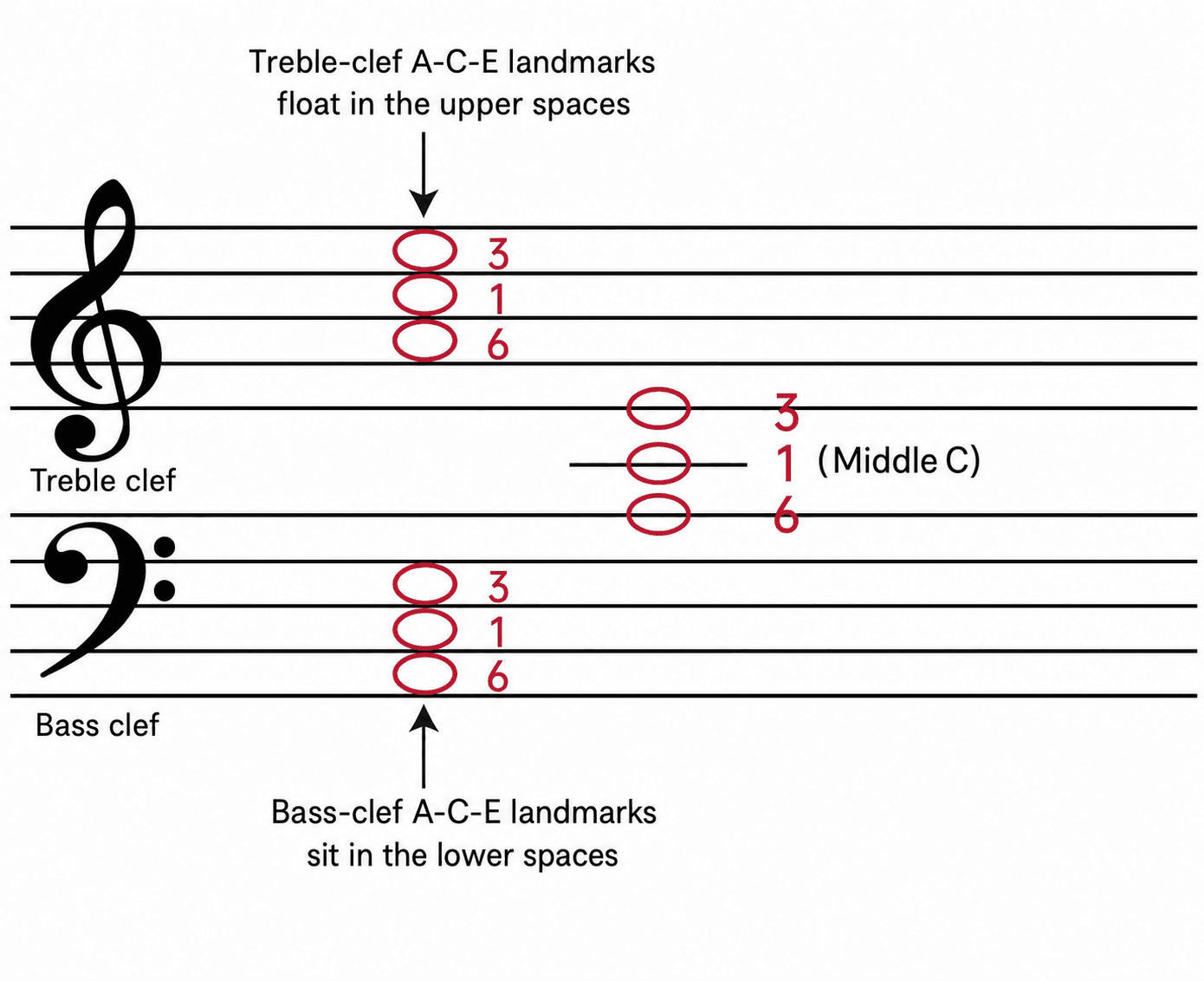
In treble clef, the second, third, and fourth spaces from the bottom are A, C, and E. In bass clef, the first three spaces are also A, C, and E. Say “A/6, C/1, E/3” while learning them so the letters remain primary.
The same alphabet continues across both staves. Moving from a line to the next space, or a space to the next line, advances one letter. musictheory.net applies the same rule to ledger lines[2].
Step 3: Read from the nearest landmark
When a new note appears, find the closest A, C, or E and move one or two positions. One step above E is F; one below is D. One step above C is D; one below is B.
| Landmark | One step above | One step below | Read it as |
|---|---|---|---|
| A | B | G | One step up or down from A |
| C | D | B | One step up or down from C |
| E | F | D | One step up or down from E |
Alternating line-space-line notes suggest stepwise motion. Consecutive line notes or consecutive space notes suggest skips of a third. First think “one step above E,” then answer F. With repetition, the spoken calculation disappears.
Ledger lines use the same method. Check the clef, find the nearest landmark, and confirm whether the note lies above or below middle C. Keep early drills within two ledger lines.
Step 4: Train rhythm separately
Pitch is only half of notation. Noteheads, stems, and flags show duration, while the time signature organizes beats. Practice pitch and rhythm separately before combining them.
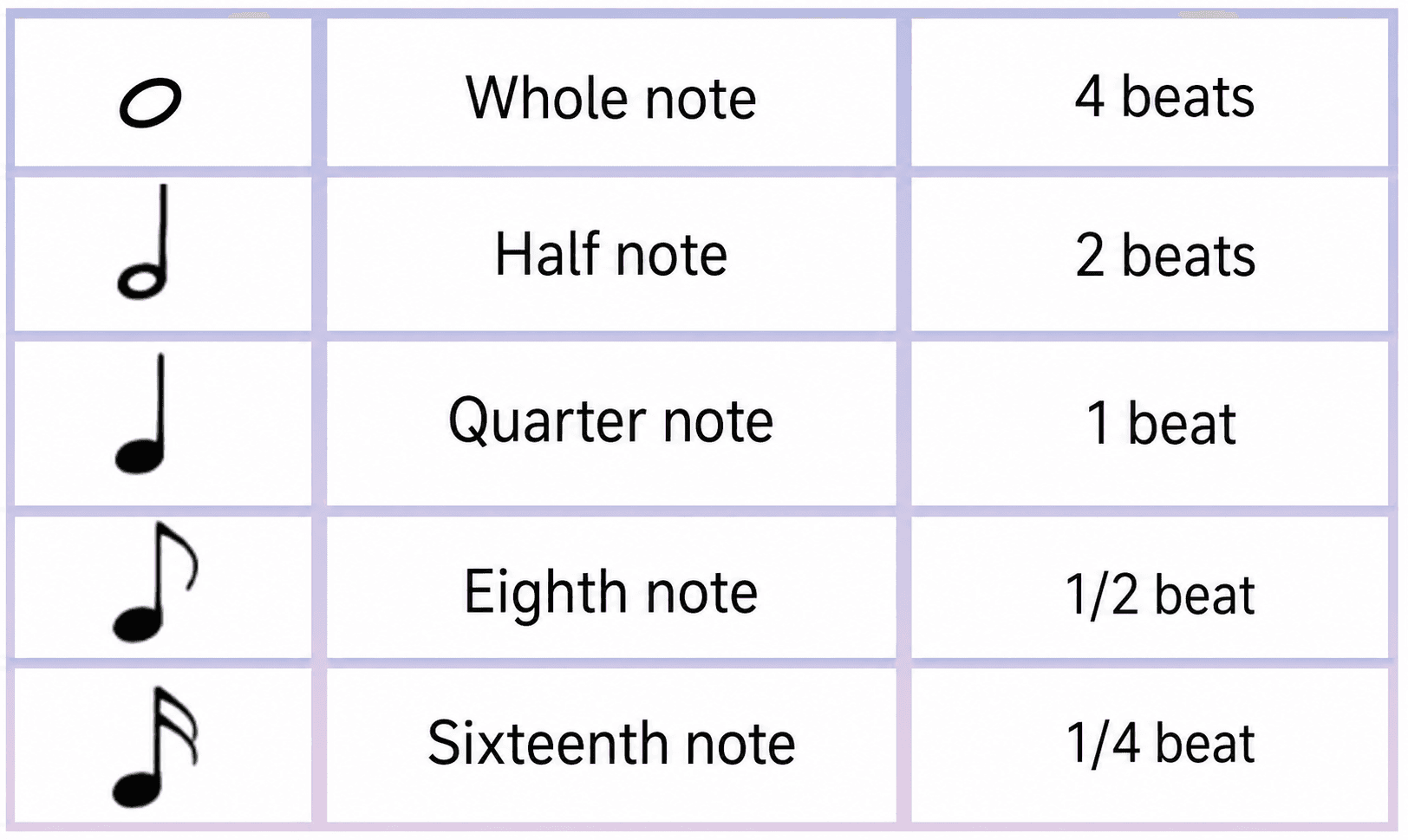
When a quarter note receives one beat, a whole note lasts four beats, a half note two, a quarter note one, and an eighth note half a beat[3]. A dot adds half of the original duration[4].
Clap rhythm on one repeated pitch. Then read changing pitches as equal quarter notes. Combine both tasks only after each one feels steady.
A 7-day practice plan
Practice for about 10 minutes a day and add one variable at a time. If errors rise, narrow the range instead of guessing faster.
- Day 1: Find every C and secure middle C.
- Day 2: Drill only treble-clef A, C, and E.
- Day 3: Drill only bass-clef A, C, and E.
- Day 4: Add notes one step above and below each landmark.
- Day 5: Add notes within two ledger lines.
- Day 6: Read quarter, half, and eighth-note rhythms.
- Day 7: Mix both clefs in the online note trainer. Time yourself only after accuracy is stable.
Use the stats dashboard to compare accuracy, note speed, and weak notes. Short daily sessions make those changes easier to see than occasional long practice.
How can you tell whether you are improving?
Before the first session, answer 20 notes within one small range. Record the number correct and the total time. On Day 7, repeat the same test with the same clef, range, and question count. Matching conditions make the comparison useful.
Check accuracy before speed. A practical target is to keep accuracy near 90% before widening the range. If your time falls but your errors rise sharply, you are probably guessing faster rather than reading more fluently.
Group mistakes by clef and staff position. If treble ledger-line notes remain slow, isolate that short range instead of restarting the entire staff. The purpose of practice data is not to chase one high score. It is to choose the next small range that needs focused work.
Move from notes to shapes
Once the landmarks feel quick, stop collecting mnemonics. Start grouping notes into direction, intervals, and repeated shapes. ABRSM's sight-reading training also emphasizes spotting key features and patterns before playing[5].
Compress “C, D, E” into “three rising steps.” Learn to see a chord as one shape instead of three letters. Then use melody challenges to practice continuous reading. Read each short passage once or twice before moving on, so memory does not replace reading.
Mistakes that slow you down
- Counting every note from middle C: use the nearest A-C-E landmark instead.
- Memorizing 6-1-3 without A-C-E: the letters stay fixed; the scale-degree numbers do not.
- Adding speed while errors increase: reduce the range and rebuild reliable answers.
- Treating treble clef as right hand and bass clef as left hand: clefs define pitch, not hand assignment.
- Using flash cards but never reading phrases: flash cards build coordinates; short scores train direction, rhythm, and looking ahead.
Frequently asked questions
Does 6-1-3 work in every key?
A, C, and E stay in the same staff positions, but they are scale degrees 6, 1, and 3 only in C major. In another key, identify the letter first, then apply the key signature.
How long should I practice each day?
Five to 10 focused minutes is enough for a daily habit. Track accuracy and average response time within the same note range instead of chasing a fixed deadline.
What is the difference between note reading and sight-reading?
Note reading identifies pitches, rhythms, and symbols. Sight-reading turns them into a first performance at a steady pulse, with fingering and musical flow included.
Where should you go next?
Build accuracy around A-C-E before widening the range. Return to the tutorial library when you need a refresher, or visit the help center for questions about practice modes, accounts, and MIDI input.
References
- [1]
- [2]The Staff, Clefs, and Ledger Lines
musictheory.net
- [3]Note Duration
musictheory.net
- [4]Dots and Ties
musictheory.net
- [5]